Comparing Approaches to Personality Assessment: Pragmatism vs. Humanism

In the digital age, the quest for self-understanding has taken an innovative turn with the rise of online personality assessment platforms. Among the numerous options available, two platforms stand out: 16Personalities and The Spiritual Seek. This article provides a detailed comparison of these platforms, exploring their unique approaches, strengths, and areas for improvement.
Decoding 16Personalities: A Pragmatic Approach
16Personalities is based on the Myers-Briggs Type Indicator (MBTI) framework. It offers comprehensive personality profiles, categorized into four groups: Analysts, Diplomats, Sentinels, and Explorers. Each group includes four distinct personality types.
Analysts: These include the Architect (INTJ), Logician (INTP), Commander (ENTJ), and Debater (ENTP). They are known for their intellectual prowess, impartiality, and analytical skills.
Diplomats: This group consists of the Advocate (INFJ), Mediator (INFP), Protagonist (ENFJ), and Campaigner (ENFP). They are characterized by their empathy and idealism, connecting with others on an emotional level.
Sentinels: The Logistician (ISTJ), Defender (ISFJ), Executive (ESTJ), and Consul (ESFJ) are part of this group. They thrive on structure, security, and stability, excelling in roles that require attention to detail.
Explorers: The Virtuoso (ISTP), Adventurer (ISFP), Entrepreneur (ESTP), and Entertainer (ESFP) make up this group. These individuals are spontaneous, adaptable, and embrace change.
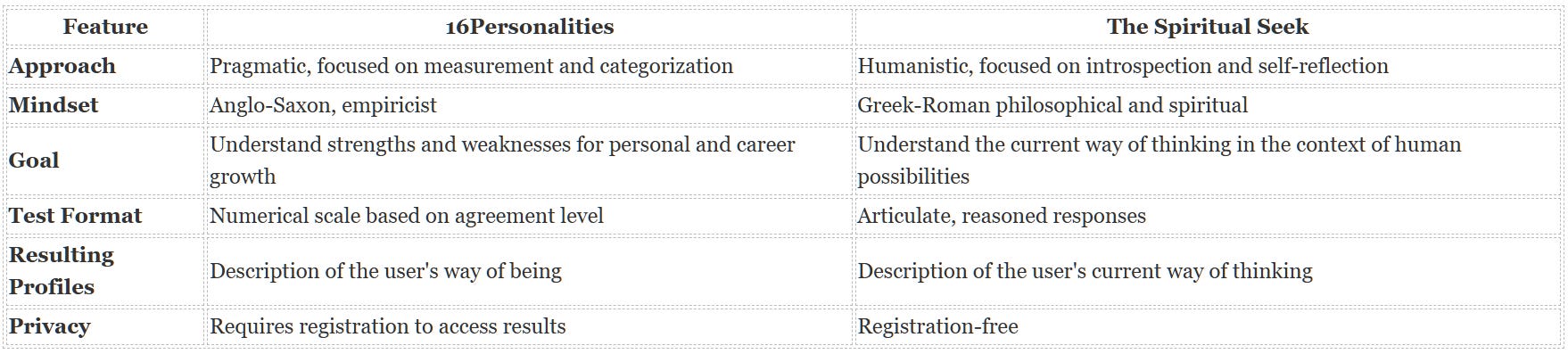
Beyond the basic personality assessment, 16Personalities offers resources for personal growth, relationships, career development, and team dynamics. These tools help users understand their strengths and weaknesses, focusing on personal growth and career integration. The platform's methodology is rooted in an Anglo-Saxon mindset, emphasizing data measurement and categorization to create mathematical predictive models. This approach simplifies complex data by fitting it into categories, which is useful for understanding workplace skills and character inclinations. However, it risks oversimplifying complex issues by losing sight of broader meanings and connections.
The tests on 16Personalities use a numerical scale based on the level of agreement with short, precise questions, making them quick to complete.
The Spiritual Seek: A Humanistic and Philosophical Approach
The Spiritual Seek takes a different approach, with psychological assessments designed to explore the complexities of the human psyche. The platform's main goal is not to provide a fixed description of personality but to capture the user's current way of thinking within the broader context of human possibilities. This approach emphasizes introspection and self-reflection, focusing on individual evolution rather than social and job growth.
The Spiritual Seek's staff is guided by a humanistic philosophy rooted in ancient Greek and Roman thought. This perspective focuses on the essential aspects that motivate human behavior, seeking the essence of things rather than the details. It is interested in the intrinsic value and meaning of things, whether they are useful or measurable. Unlike the pragmatic approach of 16Personalities, The Spiritual Seek begins with the individual and expands to the social context.
The tests on The Spiritual Seek feature articulate, reasoned responses, compelling the user to carefully read and consider their options. This requires a more active and strenuous approach than the numerical scales used by 16Personalities. The results of The Spiritual Seek tests focus on describing the user's current way of thinking, providing food for thought and constructive criticism, rather than providing a description of the user’s way of being.
Key Differences Between the Two Platforms
The Spiritual Seek's tests include:
The Mental Age Test: This assesses an individual's attitude toward life, determining if they think like a hopeful youth or a weary individual.
The Awareness Test: It explores a user's ability to perceive and understand the world around them using non-obvious questions and a pyramid-based scoring system.
The Awakening Test: This test is designed to gauge the user's level of spiritual awareness and open-mindedness.
The Great Personality Test: Inspired by the Myers-Briggs indicator, it is a comprehensive assessment tool with 65 questions, each with five reasoned responses. It uses a self-calibration feature to improve accuracy, and recommends multiple attempts.
Additional Tests: There are also tests like the Logical Intelligence Test, the Youth Wisdom Test, and the Impossible Quiz.
The Great Personality Test: A Deep Dive
The Great Personality Test stands out as a sophisticated instrument that moves beyond conventional questionnaires. Instead of using a Likert scale, it uses up to 65 questions, each with five reasoned response options. This system encourages a careful examination of alternatives rather than instinctive selections. The test is inspired by both the Big Five model and the MBTI. It is designed to be self-calibrating, and the best results are achieved on the second and third attempts. The test probes 16 major personality traits:
Sociability: (unsociability to expansiveness)
Rationality: (irrationality to rationality)
Emotionality: (impulsiveness to self-control)
Perfectionism: (carelessness to fussiness)
Liveliness: (laziness to dynamism)
Extroversion: (introversion to extroversion)
Conscientiousness: (recklessness to judiciousness)
Sensitivity: (insensitivity to sensitivity)
Tolerance: (indulgence to strictness)
Creativity: (conventionality to originality)
Sagacity: (naivety to shrewdness)
Self-Confidence: (insecurity to self-confidence)
Autonomy: (obedience to self-determination)
Spirituality: (materialism to spirituality)
Irony: (seriousness to childishness)
Selfishness: (egocentrism to altruism)
Each of these traits is described along a spectrum, with detailed explanations of how they manifest in individuals. For instance, sociability ranges from unsociability to expansiveness; rationality moves from irrationality to rationality; emotionality goes from impulsiveness to self-control. Perfectionism is described as a spectrum ranging from carelessness to fussiness, and liveliness is the transition from laziness to dynamism. The test also explores concepts like extroversion, moving from introversion to extroversion, and conscientiousness, which ranges from recklessness to judiciousness. It examines sensitivity, moving from insensitivity to sensitivity; tolerance, which is the spectrum from indulgence to strictness; and creativity, ranging from conventionality to originality. Further traits include sagacity, moving from naivety to shrewdness; self-confidence, which ranges from insecurity to self-confidence; autonomy, which is the transition from obedience to self-determination; and spirituality, ranging from materialism to spirituality. Finally, irony, which spans seriousness to childishness; and selfishness, which ranges from egocentrism to altruism are explored.
The results include an analysis of psychic energy level, which reflects mental dynamism and vigor and can act as an amplifier, depending on the traits with higher percentages.
The platform also offers insights into how personality traits are expressed in spiritual terms. Masculine traits include rationality, self-confidence, irony, and perfectionism, while feminine traits include emotionality, sensitivity, tolerance, and creativity. Balancing traits (spirituality, autonomy, conscientiousness, and sagacity) reflect inner maturity, and unbalancing traits (selfishness, sociability, liveliness, and extroversion) reinforce masculine or feminine tendencies.
The test results are not meant to be definitive but to be a starting point for further exploration. The platform emphasizes the importance of self-awareness and encourages users to consider the gap between their perceived self and their behavior in the real world.
Complementarity Rather Than Opposition
In conclusion, both 16Personalities and The Spiritual Seek offer valuable tools for self-discovery. While 16Personalities provides a pragmatic and descriptive analysis of character from a social and work perspective, The Spiritual Seek focuses on introspection and individual thinking. Both platforms provide complementary approaches to understanding the self, and they can be used in parallel to gain a comprehensive picture of one’s character. The Spiritual Seek recommends that if you take the 16Personalities test first, you will be able to appreciate the unique aspects of the tests provided by The Spiritual Seek more fully, or vice-versa.
Take the Journey of Self-Discovery
Are you ready to explore the depths of your personality? The Great Personality Test, developed by The Spiritual Seek Portal, offers a unique and insightful journey into your inner self. With its focus on reasoned responses and a self-calibrating design, this test provides a personalized and accurate profile of your character. You can also try the free demo. Discover your strengths, understand your motivations, and gain valuable insights into your unique way of thinking. Take The Great Personality Test today, and embark on a path of self-discovery.


Comments
Post a Comment